Research Entry #2
The Power of Illustrative Representation
This entry's focus is on Chidiebere Ibe, a Nigerian medical student recognized for creating inclusive medical illustrations. He went viral in 2021 for creating an illustration of a Black pregnant woman. Historically, medical textbooks have defaulted to white representations for anatomical studies. This is a dangerous practice, as it often leaves practitioners unprepared to identify conditions on darker skin tones. Since this viral illustration, he has expanded his portfolio through the Illustration Change project, which features medical illustrations of people of color. His recent work covers conditions as they appear on darker skin tones, including atopic dermatitis, lupus, and breast cancer. In relation to my project, I can use representation as a tool for validation and world-building.
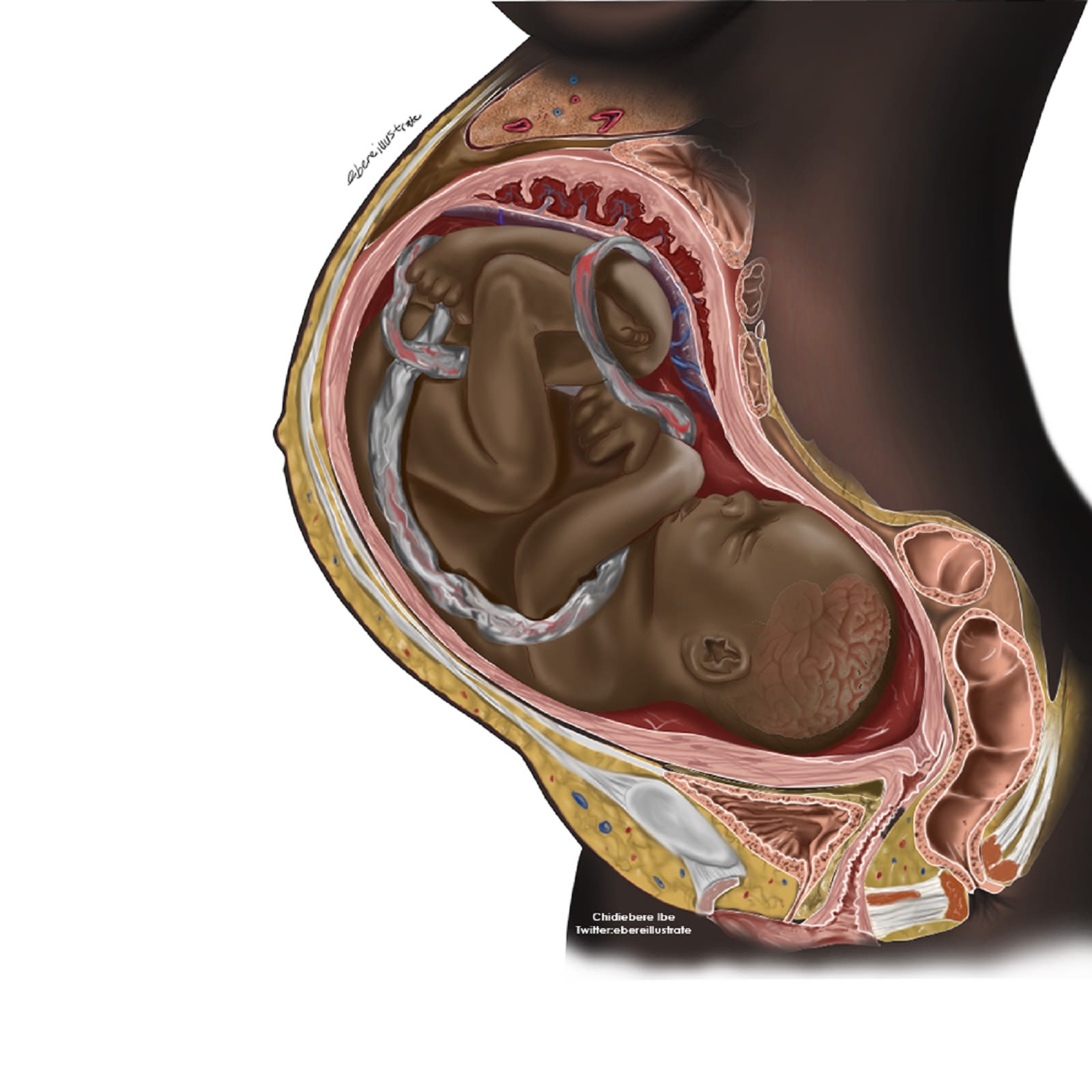 |
| Chidiebere Ibe's Black Fetus Illustration To further this research, I also looked into the Mind the Gap handbook by Malone Mukwende. Mukwende is a British medical student originally from Zimbabwe. He became a global advocate for medical equity after identifying critical faults in how doctors are trained to recognize symptoms in patients of color. This resource complements Ibe's illustrations by providing a guide to clinical signs on black and brown skin. Together, these resources highlight a systemic gap where the absence of diverse imagery leads to a lack of empathy and understanding in professional fields.  |
- "Deloitte Launches 'Illustrate Change' Medical Illustration Library." Practical Dermatology, 20 June 2023, practicaldermatology.com.
- "Medical Student in the UK Creates Handbook of Clinical Signs on Darker Skin." The Hospitalist, 17 July 2020, community.the-hospitalist.org/2020/07/17/medical-student-in-the-uk-creates-handbook-of-clinical-signs-on-darker-skin/.


I really love how you are able to find inspiration from anatomy and medical textbooks and how you are connecting this underrepresentation in the medical world to the fictional world of animation. Using this as research not only educates you and your viewers, but also your drawings and finished designs. By becoming aware of the injustices and underrepresentations that people of color and minorities face, I have no doubt that your project will embody equality and representation for all. Great job tying it all together!
ReplyDeleteThe connection you made between representation in medical illustrations and fantasy world-building is really cool, and I think it’s such an important point about who gets seen as the “default.” Excited to see how this influences your project.
ReplyDelete